
If you're familiar with my Film Composer's Recipe Book, you'll know that nearly any genre can be broken down into the 4 main ingredients of music - Melody, Harmony, Rhythm, and Orchestration!
It's a relatively simple way to organize and understand the characteristics of popular film and tv genres based on those four categories.
Today, I'm really excited for us to to step back and share how the SCORE Framework is a natural evolution, expanding on the importance of those ingredients!
Now, I love a good acronym and SCORE is a great way to simplify the composing process while keeping the bigger picture in mind. Each letter stands for:
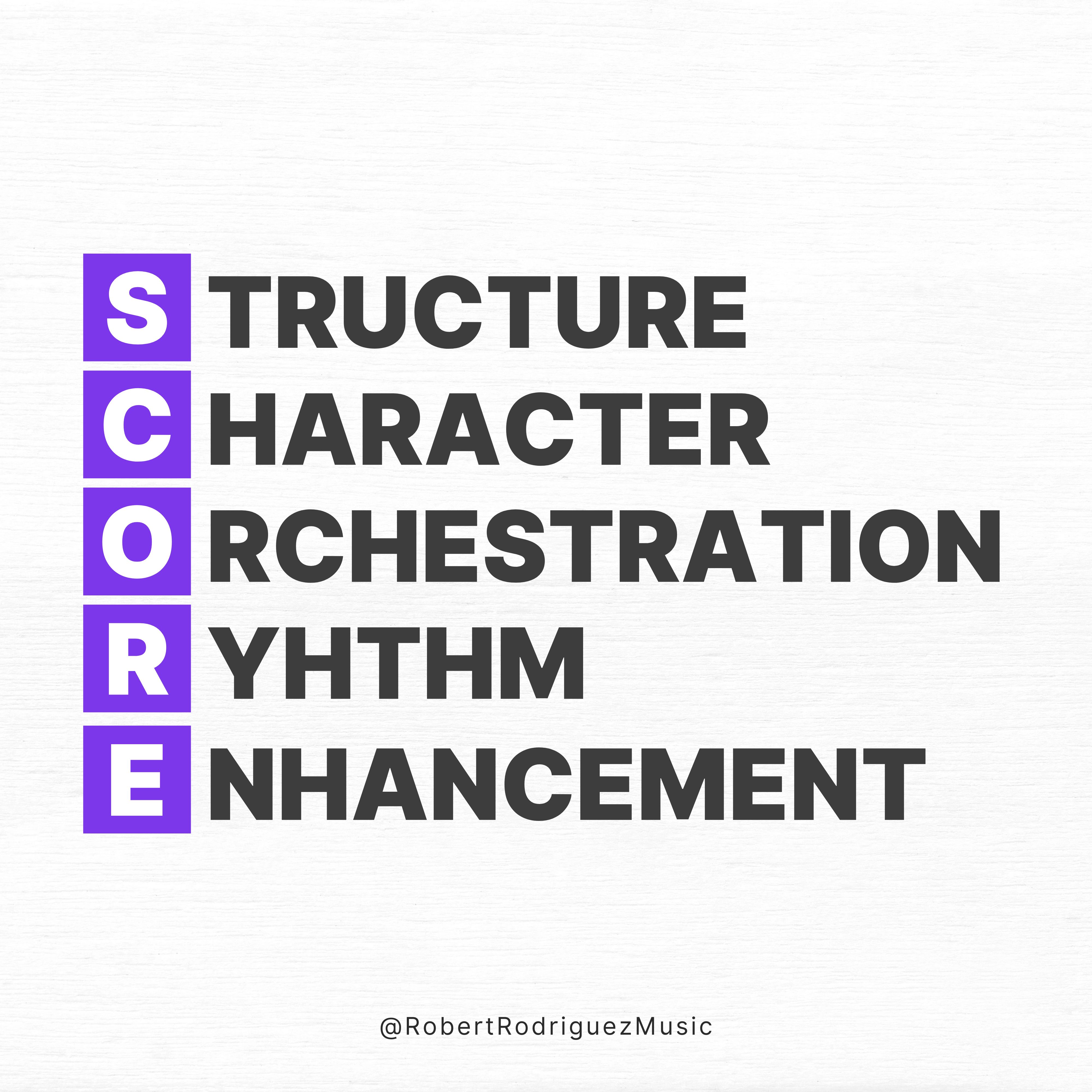
🏗️ Structure: Foundation for Coherent Storytelling
Structure is the backbone of any composition! This gives us a framework for how our music is designed to unfold over time.
Understanding and manipulating structure allows us as composers to guide the listener through a coherent musical journey! We ultimately want to make sure that each section contributes meaningfully to an overall narrative.
In a pop song, your structure might include the intro, verse, chorus, bridge, and outro. In classical music, it might be in the form of exposition, development, and recapitulation.
For film and game music, this often involves thematic development and leitmotifs that often mirrors the narrative elements of what's on screen! Understanding structure is essential in crafting a coherent and engaging musical narrative.
🎭 Character: Emotional Depth and Resonance
At the very heart of music's power is its character. Focusing on the character of music involves diving into the emotional and expressive qualities of your composition.
Ask yourself how you can you shape the character through major vs minor tonalities, the line between dissonance and consonance, dynamics, tempo changes, harmonic progressions, etc.
All of this can be subtle or pronounced! But it's up to composers to use character to evoke specific emotions, enhance the mood of a scene, and provide an emotional counterpoint to the visual narrative! How can you use music to connect with your audience?
🎺 Orchestration: Color and Texture
Effective orchestration is about choosing the "right" combination of instruments and sonic textures to bring out your intended mood or style. This is the aspect of writing music that I love to experiment with!
I try to use orchestration to breathe life into a piece. Honestly, it's like an extension of character! We want to use our ensemble to somehow resonate with our audience!
Now, your ensemble could be a traditional orchestra, maybe electronic elements, solo instruments, or some kind of combination! You always want to be mindful of how timbre, range, inherent dynamics, and the role of each instrument within the ensemble impacts your music overall.
🎶 Rhythm: Driving Energy and Movement
Rhythm is the element that creates pulse, momentum, and pacing within a piece. In film and game scoring, rhythm can be used to heighten tension, underscore action, or provide relief. It's all about energy!
This is such an important element of music because you're thinking about tempo, time signatures, syncopation, patterns, and the relationship between rhythm and melody...all while aligning your music with the pacing of the narrative and overall story!
You want to allow the energy of what's happing on screen to dictate the rhythm of your music!
📈 Enhancement: Complementing the Narrative
Enhancement in music composition involves understanding exactly where and how the music will be used. What's the context?
This means that as a composer, your score needs to complement and enhance the narrative, visual elements, any interactive aspects, all without overshadowing them!
In that case, what can you do to consider genre, cultural influences, period setting, character themes, or thematic material? Music that's well-integrated into its context can absolutely enhance the audience’s experience, making the overall work feel more cohesive and impactful!
I tried to make SCORE framework build on the foundations laid out by the Film Composer's Recipe Book.
It offers more of a holistic approach to composition for film and other media. By focusing on Structure, Character, Orchestration, Rhythm, and Enhancement, you'll be more equipped to write music that's not just musically sound but also deeply integrated with its visual and narrative context!